Decoding Your Pain: A Visual Guide to Headache Types and Management
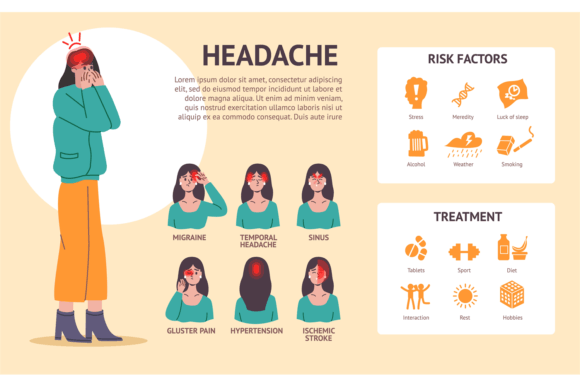
Headaches are a universal human experience, yet their nature and origin can be profoundly different. Understanding the specific type of headache you are experiencing is the critical first step towards effective management and relief. While textual descriptions are helpful, visual tools like Different Headache Types Infographics. C and other headache type infographics transform complex medical information into accessible, actionable knowledge. These visual guides, often featuring a cartoon woman with selected face areas or a clear pain localization banner, serve as a bridge between personal experience and clinical understanding.
The Visual Language of Pain: How Infographics Clarify Headache Types
A common hurdle in managing headaches is accurately communicating the symptoms. Describing pain as "throbbing" or "pressure" can be subjective. Headache infographics standardize this description through visual cues. A well-designed pain localization banner instantly shows whether the pain is unilateral, bilateral, frontal, orbital, or occipital. Seeing a cartoon woman with highlighted face areas corresponding to cluster headache pain or sinus pressure provides an immediate, intuitive reference point that words alone often fail to convey. This visual language empowers individuals to track their symptoms with greater precision and discuss them more effectively with healthcare providers.
Primary Headaches: Visualizing the Most Common Culprits
Primary headaches, where the headache itself is the main problem, are best understood through their distinct visual profiles in infographics.
- Tension-Type Headaches: Often depicted with a band-like pressure across the forehead or a diffuse ache encircling the entire head, like a tight hat. These are the most common, typically related to stress or muscle strain.
- Migraines: Infographics powerfully illustrate migraines as often one-sided, pulsating pain. They frequently incorporate visual symbols for associated symptoms like light sensitivity (a shining sun with an 'X'), nausea (a swirling stomach), or visual aura (zigzag lines). The link between stress and migraines is a common focal point, showing the trigger leading to the painful cascade.
- Cluster Headaches: These are vividly shown as intense, sharp pain localized strictly around one eye, often with a red, weeping eye depicted. The cyclical "cluster" period pattern is a key informational element in such visuals.
Secondary Headaches and Systemic Risk Factors
Secondary headaches are symptoms of another underlying condition. Infographics here play a vital role in education about risk factors and disease treatment. A visual might link sinus infection imagery to frontal face pain, or show a cervical spine problem radiating pain to the occipital region. They highlight risk factors like hypertension, medication overuse, or underlying infection, not just as text lists, but as interconnected concepts leading to the painful symptom. This reinforces the idea that treating the headache may require treating the root disease.
From Symptoms to Strategy: Treatment Pathways Illustrated
Beyond classification, modern headache infographics map the journey from recognition to relief. They segment information into phases: recognizing the painful symptoms through visual cues, identifying potential personal triggers, and outlining stratified treatment approaches. This might show a pathway from lifestyle modification for tension headaches to specific abortive and prophylactic medications for migraines. The vector concept (EPS, JPG) design allows for clear, scalable graphics that are easily reproduced in patient handouts, educational websites, and clinical software, ensuring consistent messaging.
The Practical Application in Daily Life and Professional Settings
The utility of these visual tools extends far beyond the clinic.
- For Patients and Consumers: They enable better personal health logging. An individual can compare their experience to the cartoon woman's highlighted zones to identify their headache type, leading to more targeted self-care and informed doctor visits.
- For Educators and Researchers: They serve as excellent teaching aids to explain neurovascular pathways or the pathophysiology of pain in an engaging manner. Variations like Different Headache Types Infographics. C can be tailored for different audience levels, from schoolchildren to medical students.
- For Content Creators and Business Owners: In wellness blogs, corporate health programs, or pharmaceutical education, these infographics provide authoritative, easy-to-digest content that improves user engagement and comprehension, adhering to helpful content principles.
- For Hobbyists and Advocates: Individuals passionate about health education can use these vector-based assets to create community support materials or awareness campaign content.
Considerations in Design and Interpretation
While immensely helpful, the use of headache type infographics requires some awareness. They simplify complex conditions; a real headache may present with overlapping features. They are diagnostic aids, not replacements for professional medical evaluation. The design must balance clarity with accuracy—oversimplification can lead to misinterpretation. Furthermore, the cultural context of the imagery (like the cartoon woman) should be considered for broad audience relevance. The best infographics use natural semantic keyword variation within their text elements, like "cephalalgia" alongside "head pain," to cater to both general and professional audiences.
Integrating Visual Knowledge into a Holistic Management Plan
Ultimately, the goal of these visual resources is to foster proactive headache management. Recognizing the visual signature of a looming migraine allows for earlier intervention. Understanding the stress-to-pain pathway illustrated in an infographic can motivate stress-reduction practices. Seeing the stark difference between tension and cluster headache pain localization prevents inappropriate self-treatment. This visual knowledge, when combined with professional guidance and personal observation, builds a robust framework for reducing the frequency, intensity, and impact of headaches. It turns a subjective, often isolating experience into a manageable condition with clear identifying landmarks and navigable routes to relief, demonstrating expertise through clarity and utility without any promotional bias.